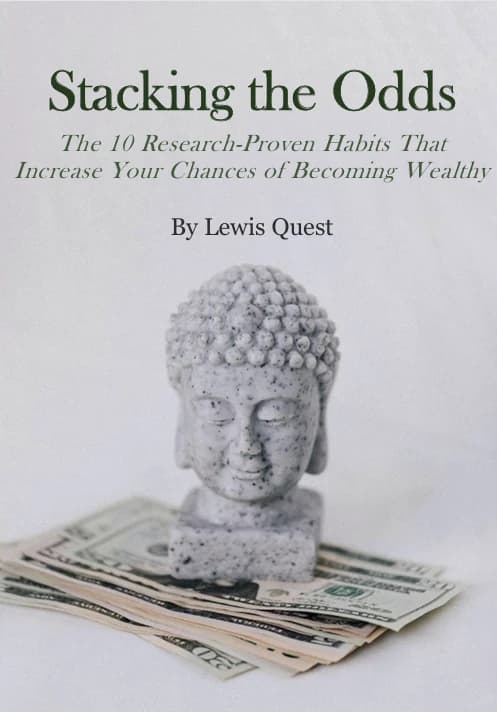
10 Research-Proven Habits That Build Wealth
Backed by 40+ cited studies from 10+ countries, covering over 290,000 participants. Published sources include The Psychological Review, Journal of Economic Theory, and Sleep Medicine.
30-day money-back guarantee. Instant PDF + EPUB download.
Wealth Is About More Than Investing
A CDC survey of 140,000 American adults found that wealthy people don't just manage money differently. They live differently.
of wealthy people read for personal development
of those struggling financially do the same
The wealthy watch less TV, exercise more, save more, and even use the internet differently. These aren't opinions. They're findings from published research.
Stacking the Odds pulls together 40+ studies from the US, UK, Japan, China, Finland, Denmark, and more into 10 changes you can start making today.
What's Inside
A CDC survey of 140,000 adults found only 55% near the poverty line get 7-8 hours of sleep, compared to 66.6% of those well above it. Japanese research shows 1 extra hour of weekly sleep raises wages 6-8%.
WHO data shows lower-income families eat fruit daily at half the rate of higher-income families (32% vs 46%). Every 10% increase in ultra-processed food intake raises dementia risk by 25%.
Americans earning over $75k are 60% more likely to hit 150 min/week of exercise. A Chinese study found regular exercisers earned 13.36% more. One aerobic session boosts executive function for 2 hours.
Millionaires and the average person both spend 46% of their time on leisure. The difference is what they do with it. 22% of the poor watch 5+ hours of TV daily. Only 8% of the wealthy do.
The average American spends 14 hours/week on social media. Millionaires spend 2.5. Research in the Journal of the Royal Society Interface shows higher-income areas use news and email more; lower-income areas use social media more.
Upper-class people are more than twice as likely to say they are "very happy" (42% vs 20%) and to rate their health as "excellent" (44% vs 19%), according to Pew Research Center data.
A study of 50,000 people across 65 countries found the wealthiest stay equally patient at any age, while the poorest become less patient over time. A Danish study of 3,600 people found the most patient are 6-7 percentiles wealthier.
Research in the Journal of Political Economy shows a strong positive link between saving rates and lifetime income. Lower-income groups spend a larger share on visible status goods at the expense of savings.
A study covered in Forbes found that people wearing "rich" attire were consistently judged more competent than identical faces in simpler clothing. It's the style, not the brand, that matters.
77% of those who struggle financially play the lottery every week. Hardly any wealthy people do. Research in The Psychological Review shows the wealthy focus on goals and actions; the poor focus on external factors.
How It Works
Buy the book
Instant download in PDF and EPUB. Read on any device.
Read in one sitting
At ~40 pages, you can finish it in under two hours. Every chapter is backed by cited research.
Apply the habits
Start with one or two changes. The research shows even small shifts compound over time.
Backed by Real Research
40+
cited studies in the bibliography
10+
countries represented in the research
290,000+
total participants across all referenced studies
Sources include:
Every claim is backed by published research. No guru opinions. Just data.
Frequently Asked Questions
How long is the book?+
Around 49 pages including the bibliography. 10 chapters, each covering one research-backed habit. You can finish it in one sitting.
Is this just generic "wake up early and hustle" advice?+
No. Every habit in the book is tied to specific published studies with real sample sizes, like a CDC survey of 140,000 adults, a 65-country study of 50,000 people, and research from Harvard Medical School. The bibliography cites 40+ sources so you can verify every claim yourself.
What format do I get?+
You'll receive both PDF and EPUB files immediately after purchase. Read on your phone, tablet, e-reader, or computer.
What if I don't like it?+
30-day money-back guarantee. If you don't find the book useful, email us and we'll refund you. No questions asked.
Why is it so cheap?+
The goal is to make research-backed information accessible to everyone. The low price removes any barrier to getting started.
Isn't this just correlation, not causation?+
Good question, and the book addresses it head-on. No single study proves causation, but the book draws on research from over 10 countries, including longitudinal studies, controlled experiments, and replicated findings in peer-reviewed journals. The weight of evidence across 40+ studies is what makes the case.
Start Stacking the Odds in Your Favour
You already have daily habits. This book shows you which ones research says matter most, and exactly how to change them.
30-day money-back guarantee. Instant PDF + EPUB download.
Questions? Contact us